Hazardous Material Management: Safe Protocols for Fuel Can Storage
Source:https://media.licdn.com
It’s a sweltering July afternoon, and you step into your attached garage or garden shed to grab a tool. Instantly, a thick, sweet, chemical odor hits the back of your throat. It’s the unmistakable smell of gasoline vapor. You glance over to the corner and notice your plastic lawnmower jug looks like a tightly wound balloon, expanding rapidly under the summer heat.
Over my ten years of working on home renovations, safety inspections, and workshop builds, I’ve walked into hundreds of residential garages. The single most common, terrifying hazard I encounter isn’t faulty wiring or unstable shelving—it’s improperly managed fuel can storage.
Many homeowners view liquid fuel as just another household commodity, like a bottle of window cleaner or a jug of motor oil. But liquid fuel behaves entirely differently. In my early days as a contractor, I witnessed a small static charge ignite unvented fuel vapors in a client’s workshop, turning a simple storage corner into an absolute inferno in less than sixty seconds. That day completely transformed how I approach residential hazardous material management, and it’s why I am incredibly strict about safety protocols today.
The Physics of Fuel: Why Liquid Isn’t the Real Danger
To master safe fuel can storage, you have to understand a fundamental rule of chemical safety: liquid gasoline doesn’t burn. The invisible vapors evaporating off that liquid are what actually ignite.
Think of gasoline like an unstable, highly volatile perfume. Even at temperatures as low as $-40^\circ\text{C}$ ($-40^\circ\text{F}$), gasoline continuously releases molecules into the air, looking for a way to escape. This temperature threshold is known technically as the flash point.
Because these vapors are heavier than air, they don’t float away into the atmosphere; they pool along the floor like an invisible, highly flammable fog. If that fog crawls across your garage floor and encounters a tiny spark—like the compressor motor of your secondary refrigerator clicking on—the entire room can flash over instantly.
Selecting Your Armor: OSHA-Approved Containers vs. Standard Jugs
When setting up your fuel can storage zone, the container you choose acts as your primary line of defense. Those cheap, flimsy plastic jugs you buy at the gas station checkout line might be fine for transport, but they are terrible for long-term storage.
Type I vs. Type II Safety Cans
If you want to store fuel like a professional, you need to transition to dedicated safety cans, which are categorized into two technical specifications:
-
Type I Safety Cans: These containers feature a single opening used for both pouring and filling. They are usually made of heavy-duty galvanized steel and include a spring-loaded, self-closing lid that automatically seals to prevent vapors from escaping.
-
Type II Safety Cans: These are the gold standard for home workshops. They feature two distinct openings—one for filling and an independent pouring spout accompanied by a built-in flexible metal hose. This dual-valve design provides built-in venting, making your pours smooth and bubble-free, which dramatically reduces accidental spills.
The Role of the Flame Arrester
A premium fuel container includes a critical component called a flame arrester. This is a fine, wire-mesh screen located inside the spout.
Think of a flame arrester like a security fence for heat. If an external spark ignites fuel vapors at the tip of the nozzle, the metal mesh instantly absorbs and dissipates the thermal energy, cooling the flame down below the ignition temperature before it can travel down into the main tank and cause a catastrophic explosion.
Engineering the Perfect Fuel Can Storage Zone
Where you choose to put your fuel is just as important as what you put it in. Let’s look at the mechanical and structural layout required for maximum residential safety.
The Location Hierarchy
Never, under any circumstances, store liquid fuel inside your main living space, a basement, or a garage directly attached to your home. If a fire breaks out in an attached garage, the common firewall only buys you about an hour of protection.
The ideal setup is a detached garden shed or a standalone storage locker located at least 50 feet away from your primary residence.
Controlling Temperature and Thermal Expansion
Fuel expands and contracts wildly based on ambient temperature. If you fill a container to the brim on a crisp morning and leave it in a metal shed that hits $40^\circ\text{C}$ ($104^\circ\text{F}$) by 2 PM, the liquid will expand, forcing hazardous vapors through the seals or rupturing the container structure.
Always leave at least a 5% to 10% air gap (headspace) at the top of your container to act as a cushion for thermal expansion.
Step-by-Step Protocol for Safe Long-Term Fuel Management
If you need to keep fuel on hand for your lawnmower, pressure washer, or backup generator, implement this precise maintenance workflow to keep your property secure.
1. Color Code Your Fluids
Never guess what is inside a container. The home improvement industry relies on a strict, universal color-coding system for safety cans:
-
Red: Gasoline only.
-
Blue: Kerosene.
-
Yellow: Diesel fuel.
-
Green: Oil-fuel mixtures (common for 2-stroke landscaping equipment).
2. Implement the 30-Day Rotation Rule
Fresh gasoline is highly unstable. Over time, volatile compounds evaporate, leaving behind a sticky, gummy residue that can ruin your small engine carburetors. Never store consumer-grade fuel for longer than 30 days without treating it with a high-quality fuel stabilizer, which can extend its shelf life up to 12 months.
3. Deploy a Secondary Containment System
Even the best safety cans can experience minor drips during a pour. Place your containers inside a heavy-duty chemical tray or a specialized secondary containment pallet made of high-density polyethylene (HDPE). If a leak occurs, this tray catches the corrosive fluid before it can soak into concrete floors or contaminate local soil.
| Parameter | Minimum Safety Standard | Professional Protocol |
| Container Material | High-Density Plastic (HDPE) | UL-Listed Galvanized Steel |
| Storage Location | Back corner of garage | Detached, ventilated utility shed |
| Max Quantity (Residential) | Up to 25 gallons total | Less than 5 gallons per container |
| Ventilation Setup | Passive wall vents | Continuous mechanical or louvers |
💡 Pro Tip: The Grounding Trick During Refills
When refilling your containers at a commercial gas pump, never leave the can inside the bed of a pickup truck or on a plastic car trunk liner. The friction of the flowing fuel generates static electricity. If the plastic can is insulated from the earth by your truck bed liner, a massive static spark can jump between the metal pump nozzle and the container rim. Always place the container flat on the bare ground before inserting the pump nozzle to safely ground the electrical charge.
The Traps of Improper Vented Cabinets
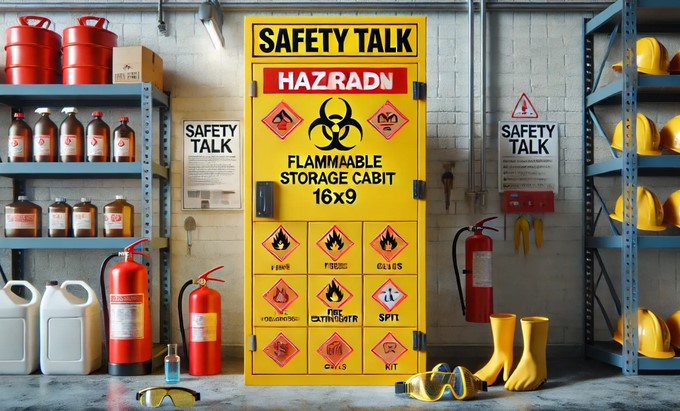
Many intermediate DIYers buy a yellow “flammable liquid storage cabinet” and think they are completely safe. However, I often see people make the fatal mistake of sealing these cabinets tightly in a poorly ventilated room.
If your storage cabinet doesn’t feature an active exhaust vent leading to the outdoors, vapor concentration inside the box can reach an explosive threshold known as the Upper Explosive Limit (UEL). The moment you open that cabinet door, a rush of fresh oxygen mixes with the hyper-concentrated vapors, creating a highly volatile air-fuel mixture that can ignite with the slightest friction from the door hinge. Always ensure your storage areas have consistent, passive cross-ventilation to keep vapor density low.
Conclusion: Protect Your Workspace, Protect Your Family
Proper hazardous material management isn’t about being paranoid; it’s about respecting the sheer chemical energy sitting inside your utility areas. By upgrading your fuel can storage with approved steel safety cans, maintaining the proper thermal headspace, and isolating your fuel zone from your living space, you drastically reduce the risk of a domestic tragedy.
Now, I want to hear from you. Take a quick look at your current garage setup. What kind of containers are you using to store your fuel right now, and what’s the one safety upgrade you plan to make after reading this guide? Let’s talk about it down in the comments section!